Transform Your Data Center: Converting vSphere to VMware Cloud Foundation

Modernizing your infrastructure and gaining the benefits of a full-stack, software-defined data center (SDDC) is a key goal for many organizations. Converting your existing vSphere environment to VMware Cloud Foundation (VCF) allows you to achieve this, automating the deployment and lifecycle management of your infrastructure. This post will guide you through the process, providing the necessary technical insights and resources.

Understanding the Conversion Process

The conversion, often referred to as a “brownfield” deployment, transforms your existing vSphere environment into a VCF-managed SDDC. This process leverages the brownfield.py script and the SDDC Manager to automate the transition.

Prerequisites

Before initiating the conversion, ensure your environment meets the following prerequisites:

  • vCenter Server:
    • Version: 8.0 U3c or later.
    • Ensure the vCenter Server Appliance (vCSA) is healthy and functioning correctly.
  • ESXi Hosts:
    • Version: 8.0 U3c or later.
    • Verify hardware compatibility with the target VCF version using the VMware Compatibility Guide.
    • All hosts must be on the Hardware Compatibility List (HCL) for the target VCF version.
  • Networking:
    • Proper DNS configuration with forward and reverse lookup zones.
    • NTP server synchronization.
    • Sufficient IP address ranges for management, workload, and NSX-T components.
    • VLANs available for management, workload, and NSX-T overlay networks.
    • MTU consistency across the network.
  • Storage:
    • vSAN health check (if applicable).
    • VMFS compatibility.
    • Storage policies should be understood before conversion.
  • Licensing:
    • Valid vSphere and NSX licenses.
  • Software Downloads:
    • SDDC Manager OVA: Download the latest SDDC Manager OVA from the VMware Customer Connect portal.
    • VCF Import Tool: This tool is usually included in the SDDC manager download package.
    • NSX-T Bundle: Download the appropriate NSX-T bundle for your target VCF version.
      • Again, this can be found at the VMware Customer Connect portal.
  • NSX-T Configuration File:
    • NSX-T JSON configuration file. This file is critical for NSX-T deployment, and includes network information, licenses, and deployment sizes.

Conversion Steps

  1. Pre-Check with brownfield.py:
    • Download the brownfield.py script. This script is usually provided by VMware.
    • Run the pre-check script on your vCenter Server to identify any prerequisites that need to be addressed.
      • Example command: python brownfield.py --precheck -u <vCenter_username> -p <vCenter_password>
    • Analyze the output and remediate any issues.
  2. Prepare the NSX-T Configuration File:
    • Populate the NSX-T JSON file with the necessary configuration details, including:
      • NSX-T license keys.
      • Deployment size (small, medium, large).
      • Network configurations (IP addresses, VLANs).
      • DNS and NTP server information.
      • Edge node information, if required.
  3. Deploy the SDDC Manager:
    • Deploy the SDDC Manager OVA to your vSphere environment.
    • Configure the SDDC Manager with the necessary network settings.
    • Verify the SDDC manager is reachable, and that it shows that it is ready for the conversion process.
  4. Run the Conversion:
    • Upload the VCF import tooling to the SDDC Manager.
    • Log in to the SDDC Manager via SSH.
    • Execute the brownfield.py script with the convert command, providing the necessary parameters, including:
      • Domain name.
      • Path to the NSX-T JSON file.
      • vCenter Server credentials.
      • SDDC manager password.
      • Example command: python /opt/vmware/vcf/lcm/lcm-app/scripts/brownfield.py --convert -d <domain_name> -n <NSX_JSON_path> -u <vCenter_username> -p <vCenter_password> -w <SDDC_Manager_password>
    • Monitor the conversion process closely. This process automates the deployment of the new NSX-T environment.
    • Be prepared to provide input as the process continues.
  5. Post-Conversion Tasks:
    • Verify the successful completion of the conversion in the SDDC Manager interface.
    • Verify the health of the NSX-T environment.
    • Validate vCenter Server integration.
    • Create workload domains as needed.
    • Apply any needed patches, and updates.
    • Test all critical workloads.

Key Technical Considerations

  • Network Segmentation: Proper network segmentation is crucial for NSX-T and VCF.
  • DNS and NTP: Ensure reliable DNS and NTP services.
  • MTU: Maintain consistent MTU sizes across the network.
  • Logging: Regularly review logs for troubleshooting.
  • API Interactions: Understand how the SDDC Manager uses APIs to interact with vSphere and NSX-T.

Troubleshooting

  • Analyze SDDC Manager, NSX-T, and ESXi logs.
  • Use API debugging tools.
  • Consult the VMware knowledge base.
  • Engage VMware support if necessary.

Converting your vSphere environment to VCF offers significant benefits, including automation, simplified management, and improved scalability. By carefully following these steps and addressing the prerequisites, you can successfully transform your data center.

The Importance of an Isolated Recovery Environment (IRE) in Cyber Recovery Strategies

In today’s digital landscape, cyberattacks pose a significant and ever-growing threat to businesses worldwide. The evidence is clear: these attacks will remain a critical concern for the foreseeable future. While the methods and tactics of attackers continue to evolve, organizations can fortify their defenses by focusing on robust recovery strategies as a vital component of a comprehensive cyber resilience plan.

At the heart of any effective cyber recovery strategy lies the Isolated Recovery Environment (IRE)—a secure, standalone “clean room” environment. This space, completely disconnected from the production data center, serves as a safe haven for handling ransomware-infected workloads. Within the IRE, organizations can power on, inspect, and recover critical systems without risking further compromise, ensuring a clean and reliable restoration process.

By integrating an IRE into your cyber defense approach, your organization can enhance its ability to bounce back from even the most sophisticated attacks, safeguarding its future in an increasingly perilous digital world.

What is an IRE/Clean Room?

An Isolated Recovery Environment (IRE) is a dedicated, secure network space designed specifically for recovering from ransomware attacks. This “clean room” environment allows organizations to safely inspect, cleanse, and restore affected workloads without risking further contamination.

While building an on-premises IRE is an option, it often involves significant upfront costs. Companies must invest in infrastructure like backup appliances, servers, network hardware, and potentially even dedicated physical sites—not to mention the ongoing management expenses.

Enter VMware Live Cyber Recovery, which redefines the IRE by leveraging a VMware Cloud on AWS Software-Defined Data Center (SDDC). This cloud-based approach eliminates the need for costly physical infrastructure while simplifying deployment and management. With VMware’s Ransomware Recovery solution, businesses can quickly provision an on-demand IRE, resulting in faster recovery times, reduced operational risk, and streamlined complexity.

Key Features of a VMware-Based IRE:

  • Secure Environment: A dedicated, cloud-based network where ransomware-infected virtual machines (VMs) can be safely powered on and assessed.
  • Built-In Recovery Tools: Integrated resources for cyber response teams to verify, cleanse, and recover VM workloads efficiently.
  • Rapid Recovery with Immutable Snapshots: Easy access to immutable backups ensures quick iteration through recovery points, speeding up the restoration process.

By transitioning to a cloud-based IRE with VMware, businesses can achieve a more cost-effective, flexible, and efficient cyber recovery strategy—ensuring resilience in the face of modern threats.

Environment Isolation

A defining feature of an Isolated Recovery Environment (IRE) is its isolation—a critical element for safeguarding the recovery process from ransomware attacks. This isolation ensures that the environment is self-contained and completely separated from production systems and external networks, creating a secure space for analyzing and restoring compromised workloads.

Traditionally, this concept is referred to as being air-gapped, meaning there is no direct network connection between the IRE, production systems, the internet, or any other internet-connected devices. This parallels the idea of a “clean room”in which virtual machines (VMs) are partitioned not only from external communication but also from one another. Access to and from the clean room is strictly controlled, and no data is allowed to leave unless it has been verified and cleaned.

How the IRE Works

The primary purpose of an IRE, or recovery SDDC, is to:

  1. Power on suspect workloads from a specific snapshot.
  2. Analyze behavior within a secure, controlled environment.
  3. Clean and stage workloads for safe recovery back into production.

To maintain the integrity of this process, the IRE is exclusively dedicated to recovery operations. It is not used for other purposes, such as testing, development, or temporary capacity expansion. Additionally, no user machines at the production site are permitted direct access to recovered VMs within the IRE.

By maintaining this level of strict isolation, an IRE ensures a secure, controlled recovery process, minimizing risks and accelerating the path back to operational stability.

Streamlining Cyber Recovery with VMware Cloud and NSX in an Isolated Recovery Environment (IRE)

A critical element of an Isolated Recovery Environment (IRE) is its secure and tightly controlled network edge. In VMware’s IRE design, the network edge is configured as an independent VMware Cloud Tier-1 Gateway, ensuring that all traffic to and from recovered workloads is routed exclusively through this gateway. This architecture prevents any connection between the IRE and production, testing, development, or QA environments. The only external connectivity allowed is to the internet, with strict NAT (Network Address Translation) applied to all traffic.

Simplifying Network Configuration

The isolated IRE setup allows recovered workloads to retain their original IP addresses by creating subnet segments attached to the Tier-1 Gateway. By leveraging NAT, organizations can reuse the same IP CIDRs for disaster recovery failover and IRE configurations without conflicts. This approach also ensures secure routing across different gateways during the recovery process.

During recovery, workloads remain within the boundaries of the IRE network, enabling safe inspection and repair. For advanced analysis, you can temporarily adjust a VM’s isolation level to observe suspicious behavior or test various network configurations without exposing production environments.

Leveraging VMware NSX for Cyber Recovery

VMware NSX is integral to the success of VMware Live Cyber Recovery by automating the creation and management of networking and security configurations. Key features include:

  • Automated Firewall and Segmentation Rules: NSX generates artifacts prefixed with “CloudDR-Isolation-xx” to manage micro-segmentation and firewall rules, simplifying operations for users without advanced networking expertise.
  • Dynamic Isolation Levels: These settings control VM access to resources such as the internet (for downloading patches) or to other workloads within the IRE. This flexibility supports behavioral analysis and validation before workloads are staged for recovery.
  • Secure Quarantine Defaults: Recovered VMs are initially attached to a “Quarantine + Analysis” network rule, allowing limited outbound access to essential services (e.g., NTP, DNS, Carbon Black Cloud). This ensures integrated analysis tools like Carbon Black sensors function effectively while preventing unnecessary exposure.

Enforcing Secure Internet Access

For VMs requiring internet access during recovery, such as to download patches or security updates, traffic is strictly controlled via the NSX Advanced Firewall Gateway and NAT. No inbound internet access is allowed unless explicitly configured for specific testing purposes. To minimize risks, internet access for IRE workloads should always route through the VMware Cloud Gateway, avoiding any connection to the production environment.

Benefits of VMware Live Cyber Recovery

With VMware Live Cyber Recovery, organizations gain a streamlined, automated approach to managing network isolation and micro-segmentation within the IRE. Highlights include:

  • Ease of Use: No advanced networking skills are needed, thanks to automated artifact creation and management.
  • Integrated Tools: Built-in support for Carbon Black Cloud and other recovery tools enhances efficiency.
  • Enhanced Security: Strict isolation policies reduce the risk of infected workloads impacting production environments.

By leveraging VMware Cloud and NSX, businesses can confidently manage ransomware recovery with greater efficiency, security, and control—protecting critical assets and reducing downtime.

VMware Live Cyber Recovery Components and Architecture

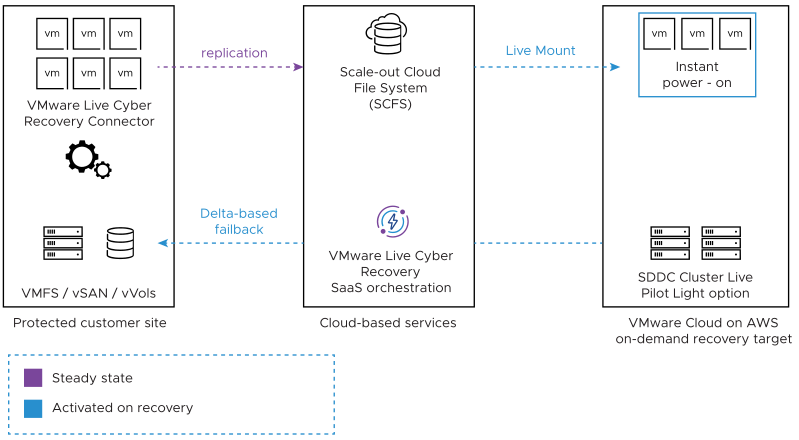
VMware Live Cyber Recovery protects VMware vSphere VMs by replicating them to a cloud file system and recovering them as needed to a VMware Cloud on AWS SDDC.

Service Components

The VMware Live Cyber Recovery service consists of the following components:

  • Cloud file system. A cloud component that enables the efficient storage of snapshots of protected VMs in cloud storage and allows VMs to be recovered quickly, without requiring data rehydration.
  • Orchestrator. A cloud component that presents a user interface (UI) to automate the disaster and ransomware recovery process on a recovery SDDC.
  • Cyber Recovery connector. A virtual appliance installed in the VMware vSphere environment to protect VMs using snapshot replication from protection groups.
  • Protection groups. A configuration component that allows you to create regularly scheduled snapshots of VMs which are replicated to the cloud file system.
  • Recovery plan. An orchestration component that defines the steps required to recover VMs from snapshots from the cloud file system to a recovery SDDC, or to recover VMs from a ransomware attack.

VMware Live Cyber Recovery cloud components (cloud file system and orchestrator) are deployed and managed by a VMware Cloud on AWS account dedicated to each tenant.

Service Architecture

The recovery SDDC is created immediately prior to performing a recovery and doesn’t have to be provisioned to support replication in the steady state.

VMware Live Cyber Recovery components work together from a protected site to cloud backup to a recovery SDDC for failover and failback.


End to End Security

Data transfers to and from protected sites to recovery SDDCs use secure replication, which ensures an SSL connection is established and used for all data transfers.

VMware Sovereign Cloud

VMware Sovereign Cloud is the most complete and secure solution for data sovereignty that protects against unauthorized access, breaches, or cyberattacks.

By working with verified partners, Sovereign Cloud keeps data completely within the jurisdiction and under the owner’s control, yet isolated from the provider’s core network and the internet.

Along with data independence, protection, management, and control, VMware Sovereign Cloud providers offer local expertise and value-added sovereign cloud services to help organizations comply with regulations and data privacy laws.

The locally implemented and operated sovereign cloud ensures flexibility, choice, and control so you don’t need to worry about vendor lock-in or excessive cost.

Local Residency (Data/Metadata)

All data must reside in the relevant sovereign country and
be subject to and compliance with the applicable local data
protection law(s).

Full Jurisdictional Control

Governmental authorities in the relevant sovereign
country where the data was obtained, have sole
jurisdictional control and power over the data and that it
is not within the legal or technological purview of foreign
governmental bodies, legal authority or access from outside
the sovereign country.

Encryption with external keys to
Clients (BYOK)

Data encryption at rest, network encryption for data in
transit and key management system (KMS) that remains
under the control of the customer or partner within the
respective country.

Local Entity

Managed by a legal entity that will own, operate and
manage the Sovereign Cloud Offering which is located
and incorporated in the applicable sovereign country
where such offering will be made available, and has no
affiliate (including but not limited to, controlling entities,
controlled entities, and entities under common control) or
any corporate relationship with any corporate entity located
outside the sovereign country where the Sovereign Cloud
Offering is made available.

Local Operations

Authorized personnel who operate and manage the
Sovereign Cloud offering to specific individuals who have
applicable sovereign country-specific security clearances
for the applicable sovereign country; and full privilege
access auditing and management.

Resiliency with 2 data center locations
(plus offline Archives)

The Sovereign Cloud Offering is managed and operated from at
least two data center locations within the applicable sovereign
country. The data centers must meet Tier III (or equivalent) or
higher data center classification, per Uptime (99.982% availability
or higher) and backup services with multiple copies.

Full Reversibility (portability without
lock-in)

Support and manage hybrid cloud deployments across different
locations (e.g., customer on-premises and cloud), with a consistent
architecture (such as VCF) that ensure interoperability between
different locations….and ability to migrate workloads to or from
the cloud without changing or reworking applications, with full
reversibility to prevent cloud vendor lock-in.

Security certification

Has relevant industry and/or government certifications
and attestations that the Sovereign Cloud offering holds and
are required in your jurisdiction for end user workloads (e.g.
ISO/IEC 27001, ISO 27017, ISO 27018, CSA STAR, Cyber
Essentials, FedRAMP, SecNumCloud, ENISA, IRAP, ISMAP,
HIPAA, PCI, etc.).

Zero Trust with Logical Network
segmentation

Follow zero trust security posture with logical network
segmentation in and across cloud country consistent with a
common policy framework.

Isolation for some or all parts of the
Sovereign Cloud offering in segregated spaces

Isolation for some or all parts of the Sovereign Cloud infrastructure
in segregated space or environment.

VMware NSX Migration for VMware Cloud Director Tool

VMware by Broadcom has announced that the NSX Migration for VMware Cloud Director tool will be available as an open-source toolkit on its GitHub repository.

Key Highlights of the Open-Source Release

  • Accessibility: The open-source availability of the NSX Migration tool will make it more accessible to a wider range of users, allowing them to customise and extend its capabilities to meet their specific needs.
  • Community Collaboration: By releasing the tool as open-source, VMware invites contributions from the community, fostering collaboration and innovation. This collaborative approach will enhance the tool’s functionality and ensure its ongoing relevance.
  • Enhanced Customization: With the open-source release, users will have the freedom to tailor the tool to their unique requirements, adapting it to their specific NSX environments and configurations.

The NSX Migration tool simplifies the process of migrating from NSX for vSphere to NSX-T Data Center, eliminating the complexities and potential risks associated with manual migrations. It automates many of the tasks involved, ensuring a smooth and efficient transition.

vExpert Overview / How to Apply


The vExpert community is a global network of VMware experts who are passionate about sharing their knowledge and expertise with others. vExperts provide valuable insights and guidance to the VMware community, helping organizations to use VMware technologies to their fullest potential.

What is a vExpert?

A vExpert is a recognized expert in VMware technologies who has made significant contributions to the VMware community. vExperts are nominated by their peers and selected by VMware based on their technical expertise, community involvement, and passion for VMware.

What are the benefits of being a vExpert?

There are many benefits to being a vExpert. These include:

  • Access to exclusive vExpert resources
  • Opportunities to network with other VMware experts
  • Recognition for your contributions to the VMware community
  • The chance to influence the future of VMware technologies

How can I find a vExpert?

The vExpert Directory is a great resource for finding vExperts in your area. You can also search for vExperts on social media using the hashtag #vExpert.

I am a vExpert, how can I get involved?

There are many ways to get involved with the vExpert community. These include:

  • Writing blog posts and articles
  • Giving presentations at user conferences
  • Answering questions in the VMware forums
  • Mentoring new vExperts


The vExpert community is a valuable resource for anyone who is interested in learning more about VMware technologies. If you are passionate about VMware, I encourage you to get involved with the community.

In addition to the above, here are some other benefits of being a vExpert:

  • Early access to new VMware products and technologies
  • Invitations to exclusive VMware events
  • Opportunities to collaborate with VMware employees
  • The chance to have your voice heard by VMware

How to Become a vExpert


To become a vExpert, you must have a proven track record of contributing to the VMware community. This could include writing blog posts, speaking at events, participating in forums, or contributing to open source projects.

If you are interested in becoming a vExpert, you can learn more about the program and apply on the following website.

https://vexpert.vmware.com

In addition to the benefits listed above, becoming a vExpert can also be a great way to give back to the community and help others. vExperts play a vital role in helping to spread knowledge and best practices about VMware technologies.

If you are passionate about VMware technologies and you are looking for a way to get involved in the community, becoming a vExpert is a great option.

I hope this blog post has given you a better understanding of the vExpert community.

If you have any questions, please feel free to leave a comment below.

I would also like to add that the vExpert community is a very welcoming and supportive group. If you are new to VMware, I encourage you to reach out to a vExpert in your area. We will be happy to help you get started.

VMware Cloud Director 10.5.1

VMware Cloud Director 10.5.1 is now available, and it brings a number of new features and enhancements to the cloud management platform. This release is focused on simplifying cloud operations, enhancing security, and improving automation.


Some of the highlights of VCD 10.5.1 include:

  • VMware Cloud Director Cell Certificate Management Through the UI
  • Newly generated self-signed certificates include SubjectKeyIdentifier and AuthorityKeyIdentifier certificate extensions
  • VCD Tenancy Aligned to NSX Projects
  • Provider Topology Intentions

    Advertisement Strict

    Advertisement Flexible

    All Networks Advertised
  • Configuration of NAT and Firewall Service Intentions on a Provider Gateway
  • NAT For Provider Gateway
  • Firewall Rules Configuration on Your Provider Gateway
  • BGP Provider and Tenant Configuration
  • BGP Permission Groups Configuration
  • NSX Advanced Load Balancer Self-service WAF
  • NSX Advanced Load Balancer Virtual Service Logging Analytics
  • DHCP Static Bindings
  • More than one IdP integration with VMware Cloud Director
  • End User License Agreement (EULA) for Container Applications Imported from VMware Marketplace
  • VMware Cloud Director Encryption Management
  • New Organization: Traversal Right
  • Standalone Virtual Machine Metadata Tags
  • The VMware Cloud Director UI displays the current organization name

Here are some additional resources that you may find helpful: