VMware Cloud Foundation (VCF) 9.0 introduces major architectural and operational enhancements for modern private cloud deployments. This article provides a technical deep dive into its core themes, covering architecture models, operational concepts, networking, storage, and key best practices relevant for enterprise IT teams and architects.
Core Architecture Themes
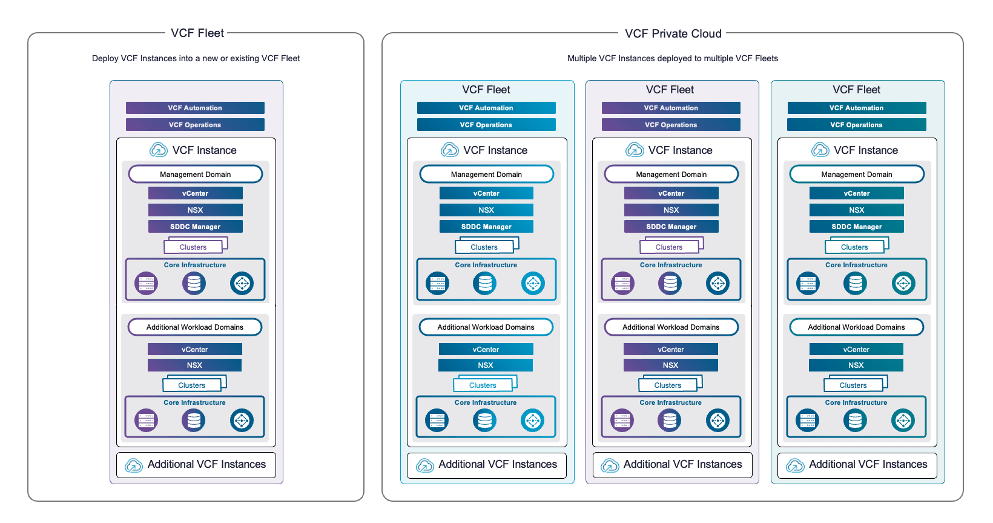
VCF 9 builds on refined domain-based architecture, enabling seamless scalability for both management and workload clusters. The solution is comprised of VCF Instances, each containing a management domain and multiple workload domains, all orchestrated through SDDC Manager. Version 9 brings more flexible fleet management to coordinate multiple instances, offering unified automation and life cycle control.
Diagram: Multi-instance VCF Architecture
Fleet Management
├─ VCF Instance 1
│ ├─ Management Domain (vCenter, NSX, SDDC Manager)
│ └─ Workload Domains (Clusters, Storage)
└─ VCF Instance 2
├─ Management Domain
└─ Workload Domains
Architecture Best Practices
| Area | Best Practice |
|---|---|
| Domain Design | Separate management and workload clusters for resilience |
| Topology | Employ multi-rack, multi-site for high availability and failover |
| Fleet Management | Use automated, centralized operations for upgrades and patching |
Operations and Automation
Operations in VCF 9 revolve around centralized life cycle management and automated monitoring. VCF Operations features single UI dashboards for fleets, intelligent log analytics, and sophisticated monitoring, integrating seamlessly with Aria Operations and leading SIEM platforms. Automated upgrades can be performed with zero downtime leveraging new live patching capabilities

Recommended Operational Workflows
| Workflow | Recommended Tool/Service | Description |
|---|---|---|
| Fleet Management | SDDC Manager, VCF Automation | Centralized patching, configuration, upgrades |
| Monitoring and Log Analysis | Aria Operations/Log Insight | Correlated logs, health checks, capacity analysis |
| Automation and API Integration | PowerCLI, REST, Terraform | Infrastructure-as-Code for deployments and recovery |
Networking and Security
Networking in VCF 9 leverages NSX-T’s powerful overlay model. NSX Federation allows multi-site policy enforcement, network segmentation, and rapid disaster recovery across interconnected VCF Instances. Security is enhanced by full-stack RBAC, MFA integration, and continuous compliance monitoring using built-in SDDC Manager audit modules.
Diagram: NSX Federation Multi-site Model
text        [NSX Federation]
         ├─ Site A (Local NSX)
         └─ Site B (Local NSX)
             │
         [Global Policy Enforcement]
Security Recommendations
| Technology | Best Practice | Rationale |
|---|---|---|
| NSX Federation | Global policies, microsegmentation | Tenant isolation and rapid DR |
| Identity Broker | SSO, MFA | Enhanced authentication |
| Compliance | Periodic audits, drift management | Maintain regulatory posture |
Storage Innovations
VCF 9 centers storage architecture around vSAN Express Storage Architecture (ESA), supporting end-to-end NVMe, global deduplication and compression, and cross-cluster “HCI Mesh” sharing. Clusters may also integrate legacy NFS or Fibre Channel storage for hybrid deployments. Always size clusters based on workload IOPS/latency targets, and validate network links (10GbE+ recommended).
| Storage Model | Main Benefits | Key Considerations |
|---|---|---|
| vSAN ESA | High performance, simplified ops | 10GbE or higher required |
| NFS/Fibre Channel | Legacy integration, flexibility | Latency and compatibility |
| HCI Mesh | Flexible cross-cluster sharing | Topology planning needed |
Key Enhancements & Practical Tips
- Unified Licensing: Subscription simplifies entitlement management.
- Workload Domain Flexibility: Partition workloads by function, location, or business unit for optimised governance.
- Automation First: Use API-based provisioning for all config and expansion tasks to improve repeatability and reduce errors.
- Proactive Security: Regularly configure and monitor RBAC, SSO, certificate expiry, and compliance status.


 gnunes.cloud