
The latest release of VMware Cloud Foundation and vSphere 9.0 marks a significant leap for private cloud innovation, promising to simplify, secure, and scale IT infrastructure while supporting the changing needs of modern businesses. Packed with advanced features, this version addresses persistent challenges in virtualization, AI adoption, and mission-critical workload management, making it a versatile choice for today’s IT leaders.

Unified and Simplified Management
VMware’s new approach consolidates infrastructure management by integrating compute, storage, and networking into a unified platform. This redesign not only streamlines day-to-day operations through fleet-wide visibility but also introduces a simplified licensing model; customers now receive a single license file encompassing all core components, eliminating the confusion and administrative overhead of tracking multiple product keys across vCenters and clusters.
Versioning and Lifecycle Improvements
The shift to straightforward version numbering reduces confusion and speeds up upgrades. Lifecycle management has been optimized, with new features like live patching allowing for host upgrades with minimal downtime. Configuration profiles and global image management further enhance consistency and control, enabling scalable, policy-driven administration—even in clusters with mixed vendor hardware.
Versioning and Lifecycle Improvements
The shift to straightforward version numbering reduces confusion and speeds up upgrades. Lifecycle management has been optimized, with new features like live patching allowing for host upgrades with minimal downtime. Configuration profiles and global image management further enhance consistency and control, enabling scalable, policy-driven administration—even in clusters with mixed vendor hardware.

Resource Management Innovations
A highlight of this release is NVMe Memory Tiering, which dramatically increases memory resources without expensive hardware investments. By leveraging lower-cost NVMe devices as memory, organizations can double or even quadruple host memory capacity, boosting the number of VMs supported per server and maximizing utilization. This translates to lower total cost of ownership, reduced energy needs, and better resource scaling for workloads that previously faced memory constraints.

Performance and AI Capabilities
vSphere 9.0 delivers breakthrough enhancements for AI and machine learning workloads. Zero-downtime vGPU vMotion allows for rapid, interruption-free migration of graphics-enabled VMs; recent improvements have cut downtime from over 40 seconds to just 2 seconds for large GPU profiles. The platform now offers full visibility into GPU resources for easy planning and cluster optimization. Intelligent placement and automated shuffling ensure clusters accommodate even sprawling GPU workloads efficiently, streamlining expansion for AI-driven operations.
Modern Workload and Kubernetes Support
Recognizing the shift toward containers and microservices, vSphere’s Kubernetes integration now provides modular, simple enablement—eliminating the need for complex load balancers and multiple control planes. Both VM-based and container workloads are natively managed with enhanced self-service options, facilitating modern application deployment while maintaining compatibility with legacy systems. Over half of organizational workloads remain VM-based, so these upgrades ensure seamless operation and future-ready expansion.
Security and Compliance at the Core
Security is no longer an afterthought. VMware embeds encryption, federated authentication, and compliance monitoring throughout the platform. Features such as drift detection, remediation, and advanced access control guarantee that even as user expectations and regulatory requirements evolve, environments stay secure and compliant. Integration across management domains allows rapid response to threats and simplifies prove-out for audit teams.
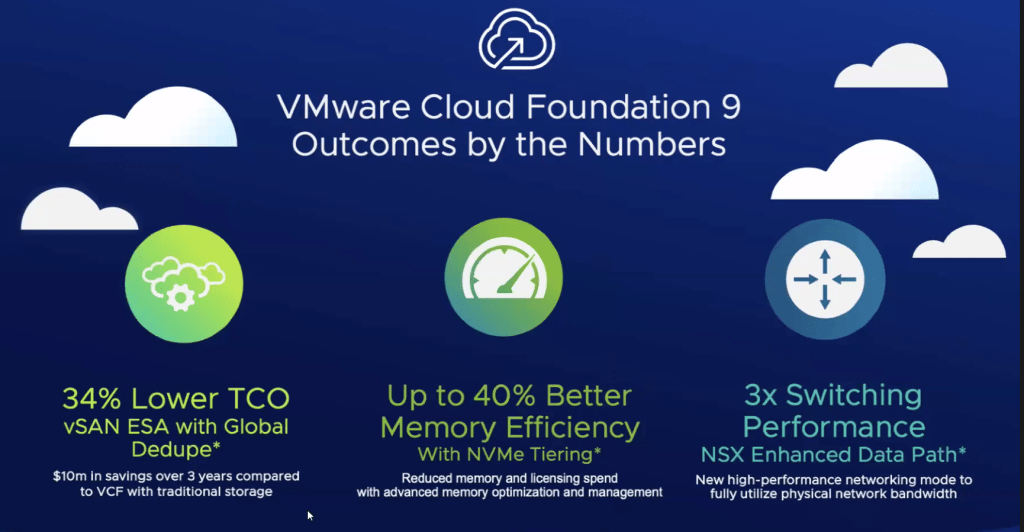
VMware Cloud Foundation and vSphere 9.0 set a new standard for private cloud infrastructure. By unifying management, unlocking scalability, and prioritizing security, this release puts enterprises firmly on the path to modern application architectures and AI adoption—without leaving legacy workloads behind. For enterprise IT, the journey to digital transformation just got a whole lot faster, simpler, and more secure.


 gnunes.cloud